
Throughout the September school holidays, the ZSP facilitators and Lab Assistants have been running training for educators from the Stage II schools. The purpose of this training was to provide educators, who are not as confident with technology, with a gentle introduction to the new computers. The educators were given a specially designed program with individual attention from the ZSP staff. The training was held at Thomas Wildschutt Junior school and neighbouring schools who kindly opened their facilities for the training.
September 30, 2010

September 24, 2010
24th September: Heritage Day
Today is a public holiday in South Africa, Heritage Day. Here is how the Government website defines today:
"The day is one of our newly created public holidays and its significance rests in recognising aspects of South African culture which are both tangible and difficult to pin down: creative expression, our historical inheritance, language, the food we eat as well as the land in which we live."
The ZSP Team were delighted to be invited to Thomas Wildchutt Junior School's Heritage Day and Thanksgiving Service.
Here are the learners celebrating their heritage.
Happy Heritage Day to all!
September 20, 2010
Teaching for the future
Last week the ZSP Team and the new Lab Assistants had the pleasure of introducing the newly installed technology to the staff of Thomas Wildschutt Junior. The staff were given an introduction into how they can use the interactive electronic whiteboards that have arrived at the school.
The aim of the first session was to allow the staff to play with and so explore the potential of their new technology.
The feedback from the educators was very positive, there was a real sense of excitement in the sessions.

The aim of the first session was to allow the staff to play with and so explore the potential of their new technology.
The feedback from the educators was very positive, there was a real sense of excitement in the sessions.

September 10, 2010
Meet the ZSP Lab Assistants and Community ICT technicians
A very important part of the ZSP is the additional staff that it provides to the schools to ensure that the educators are supported with their use of the technology.
A full time Lab Assistant is provided to every ZSP school. Apart from supporting the school, the aim is to train and develop the Lab Assistant during the life of the Project. We have found that the contribution of the Lab Assistant is crucial to the use and integration of the technology
A Community ICT Technician is provided for a cluster of schools.Young matriculants are selected to follow a learnership program.
Click here to see the album with details of names & schools
September 6, 2010
August 30, 2010
AUP - recipe for success!
For the past month the second phase of ZSP schools have been working hard on their AUP.
What is an AUP? Acceptable User Policy. This is the document that regulates how the computer centre is organised, maintained, kept safe, how educators use the new facilities, and how the different responsibilities for the upkeep of the facilities are allocated to the ICT Committee.
This may not sound too important, but these policies are crucial in ensuring that the computer centre is used optimally, for delivering numeracy and literacy lessons and in supporting educators with their admin tasks.
As part of this process, it is important that the schools involved formulate policies that will help them to keep their computer centre functioning to the best of its potential and also minimise any risks e.g how to stop viruses being spread via USB sticks.
The ZSP Team provided each school with a list of topics would need to be addressed by the AUP, we were also available to advise schools during their discussions. In some schools the whole staff have sat down together to decide on their AUP.
By the time the technology arrives at the schools, this recipe for success will be in place.
August 18, 2010
Report from Thomas Wildschutt Primary learners
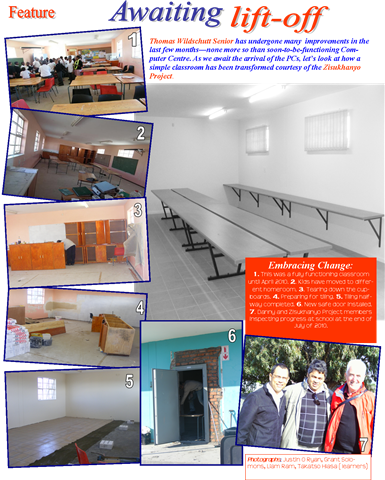
To see the full size report click on the link:
Thomas Wildschutt learners' report
Thomas Wildschutt learners' report
This is an excellent record by the learners of the work that has been happening at their school.
As you can see they are eagerly awaiting the arrival of the technology.
Thanks to Justin O Ryan, Grant Solomons, Liam Ram, Takatso Hlasa and Mr Ryklief.
As you can see they are eagerly awaiting the arrival of the technology.
Thanks to Justin O Ryan, Grant Solomons, Liam Ram, Takatso Hlasa and Mr Ryklief.
August 10, 2010

August 4, 2010
Mitchell's Plain Cluster: Progress to date
The Control Board meeting was held on Friday July 30th. The Control Board meeting is a chance for all the stakeholders to report how they are progressing towards the strategic objectives of the Project.
It was a very productive and encouraging meeting where the full scope of the Project was clearly demonstrated. To document all the feedback would take too long, but some key points that were shared included:
how many extra learners had received much needed food at school
how a holiday feeding scheme had been put in place
the details of peer educator HIV training
the screening and treatment of learners with eyesight difficulties in a pilot project at one school
the development of lab assistants and a community ICT technician
the training and development of educators who had little or no exposure to computers prior to ZSP
the focus on using computers as an important tool in raising the standards of numeracy and literacy in the Mitchell's Plain cluster schools
Part of the meeting was an honest assessment of the strategies needed in the next six months to allow further progress to occur.
An example of what is happening in the schools. Below is a video (please excuse the quality as it was shot using a cell phone) of grade 1 learners (6-7 years) totally engrossed in their maths...one of the ZSP successes!
July 21, 2010
Seeing is believing
Part of the scope of the ZSP includes the funding of the Jonga Trust in a pilot eye screening project. The funding has also allowed the Trust to provide glasses to the learners identified with eye sight deficiencies during the school screening mentioned in an earlier post ( Jonga Trust blog post). More serious cases were referred to the Red Cross Children's Hospital, under the funding of the Health Department.
Today the learners were proudly wearing their new spectacles during the lesson in the ZSP computer centre.

Subscribe to:
Posts (Atom)
